See the item in the
Perlman's Collection!
A terracotta figure of a woman with a fan and hat. She wears a himation and chiton as
well, but also a tholia, a broad brimmed sun hat which here is connected with a small
metal pin. She holds a fan in her hand, another standard form. Many of these figures are
based on tropes from New Comedy, a theatrical style where comedy evolved to be more
character driven rather than politically satiric. It was also once brightly painted,
here the red is preserved particularly well on her lips and fan.
Credit: Carleton College Art
Collection
Sources:
Barrow, R., & Silk, M. (2018). Gender, Identity and the Body in Greek and Roman
Sculpture (1st ed.). Cambridge University Press.
https://doi.org/10.1017/9781139600439
Minniti, Kate. (2015). Tanagras in Cross-Cultural Context: A Study on Stylistic
Variability Across the Mediterranean. In Current Research in Egyptology. Oxbow Books,
Limited.
http://ebookcentral.proquest.com/lib/carleton-ebooks/detail.action?docID=2089595
Introduction
Our project, Greek History Rebuilt, focused on creating 3D models of Greek objects hosted by the
Perlman Teaching Museum at Carleton College. Given the Perlman's vast collection, we chose a
subset of artifacts, based on object type (decorative and utilitarian) and location (Greece).
This particular combination of descriptors was fitting given our group's interest in classical
history.
Project Origins
As we started thinking about what we might focus on for this project, we were particularly
interested by the various historical objects that Carleton has in its collections. Sam, through
her work in the Archaeology Department, has had exposure to artifacts excavated on Carleton's
grounds, and most of the group has had class and personal visits to the Perlman, Carleton's
teaching museum. Given that many of the artifacts excavated by the Archaeology Department have
already been modeled, we decided to explore Carleton's connections to past societies through the
Perlman's collection. Our common interest in Greek and classical history led us to explore the
objects tagged as Grecian; as we did so, we realized that not only was there fairly little
information about these artifacts, some also did not have photos. We decided to model and
research these objects, both as a way to learn more about Carleton's archival collections and
interactions with Greek antiquity and as a way to increase the resources available to the
Perlman and hopefully increase the visibility of this part of their collection.
Sources
After going through the Perlman's collections, we decided to center our project around twelve
objects, all of which were definitively or potentially associated with Greece, and all of which
were tagged as decorative/utilitarian objects. The artifacts are all constructed either of
bronze, copper, or terra cotta, and have been sorted on this page as either metal or clay. Of
the twelve items, there are two terra cotta statues, three terra cotta vases (of varying shapes
and sizes), four bronze and one copper domestic items, one bowl, and a bronze figure. These
artifacts encompass a range of time periods, uses, and artistic qualities, and provide a
compelling diversity of focus to this project.
Process
After connecting with staff at the Perlman and ensuring that this project was feasible given our
various time and resource constraints, we began photographing and modeling the objects. Our
initial plan was to use a digital camera to capture photographs of each object, which we would
then use to create a 3D model on the modeling platform MetaShape. However, difficulties with the
coverage, lighting, and number of photographs meant that the MetaShape models were unusable. We
had to pivot our approach to the project, and instead modeled the objects using Scaniverse, a
mobile app that produces 3D models from video footage of objects.
Explore metal items! Explore clay items!
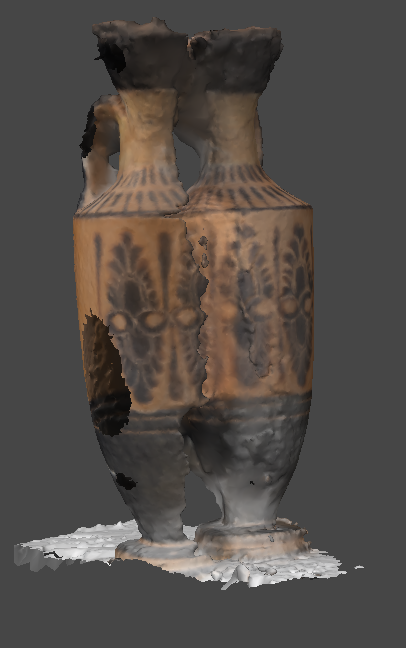
First example of a Metashape model
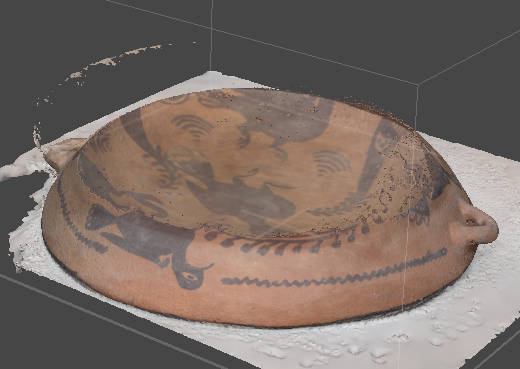
Second example of a Metashape model
This website was first designed using Figma, where we created this design prototype, to reach a style and organization that we all enjoyed. Afterwards we searched for a Bootstrap template that resembled that initial design and modified it to suit our needs. The creators of the template can be found credited at the footer of each page.