See the item in the
Perlman's Collection!
A tall bronze kyathos. Both the word, κύαθος, and the shape could refer to either a
ladle or a cup. The tall variety were mainly cups. The metal material is unusual for
Greece, if that is indeed its origin, as many similar bronze kyathoi are Etruscan. No
decoration remains on the body of the vessel. Probably Hellenistic or late Classical in
period.
Credit: Carleton College Art Collection
Sources:
Puma, R. D. D., & N.Y.), M. M. of A. (New Y. (2013). Etruscan Art in the Metropolitan
Museum of Art. Metropolitan Museum of Art.
Silver kyathos (ladle) with bronze handle. (400 C.E.). [Bronze, Silver].
https://www.metmuseum.org/art/collection/search/248654
Rasmussen, T. (1985). Etruscan Shapes in Attic Pottery. Antike Kunst, 28(1), 33-39.
Richter, G. M. A., & Metropolitan Museum of Art (New York, N. Y. ) (with Wellesley
College Library). (1915). Greek, Etruscan and Roman bronzes. New York [The Gilliss
Press].
https://libmma.contentdm.oclc.org/digital/collection/p15324coll10/id/31692/
Metals
These objects are made of metals such as bronze and copper
See the item in the
Perlman's Collection!
A bronze oil lamp with a man wearing a phrygian cap at the handle end. Potentially
missing its top piece, it appears most like Roman period bronze lamps. Similar ones
usually bear theater masks. The protrusion under the chin may be either a beard or
another design, like palmettes.
It may represent the god Attis, who was often
represented as a youth
wearing a Phrygian cap.
Credit: Carleton College Art Collection
Sources:
Green, J. R. (2012). ROMAN BRONZE LAMPS WITH MASKS: DIONYSOS, PANTOMIME AND
MEDITERRANEAN POPULAR CULTURE. Herom, 1, 23-65.
https://doi.org/10.11116/HEROM.1.2
Bussière, J., & Wohl, B. L. (2017, August 1). Ancient Lamps in the J. Paul Getty Museum
[InteractiveResource]. J. Paul Getty Museum, Los Angeles.
http://www.getty.edu/publications/ancientlamps
British Museum. Dept. of Greek and Roman Antiquities, & Walters, H. B. (with Wellesley
College Library). (1914). Catalogue of the Greek and Roman lamps in the British museum.
London, Printed by order of the Trustees.
http://archive.org/details/catalogueofgreek00brit
Lamp | British Museum. (n.d.). Retrieved March 10, 2025, from
https://www.britishmuseum.org/collection/object/G_1851-0813-23
See the item in
the Perlman's Collection!
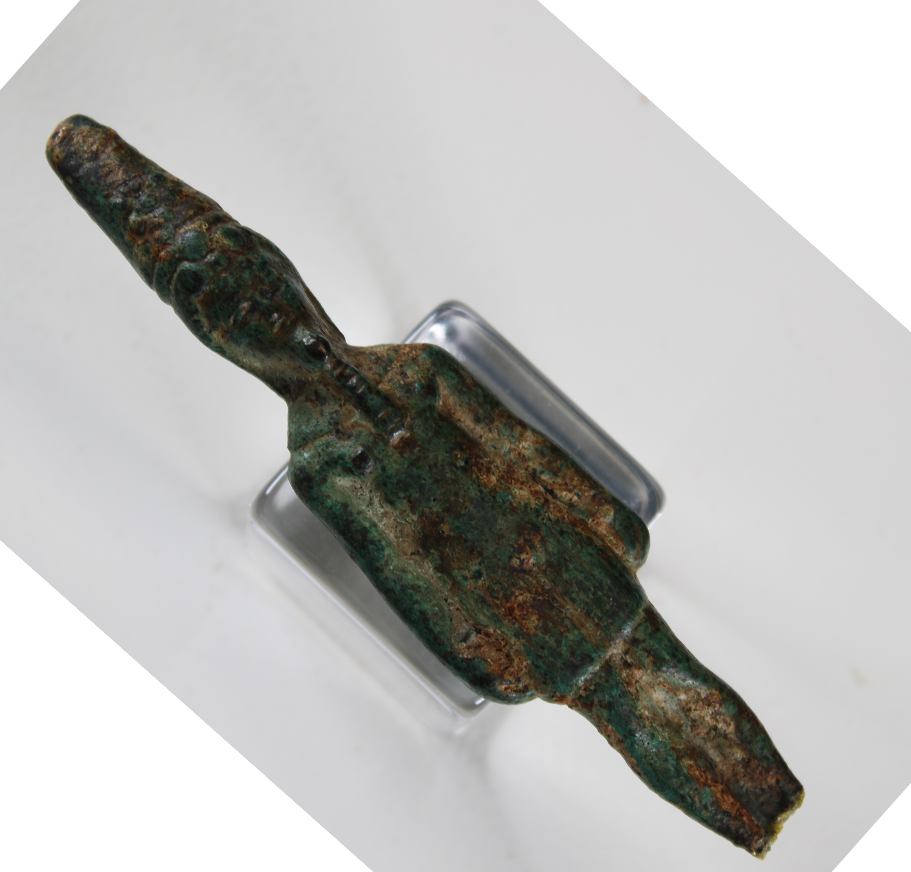
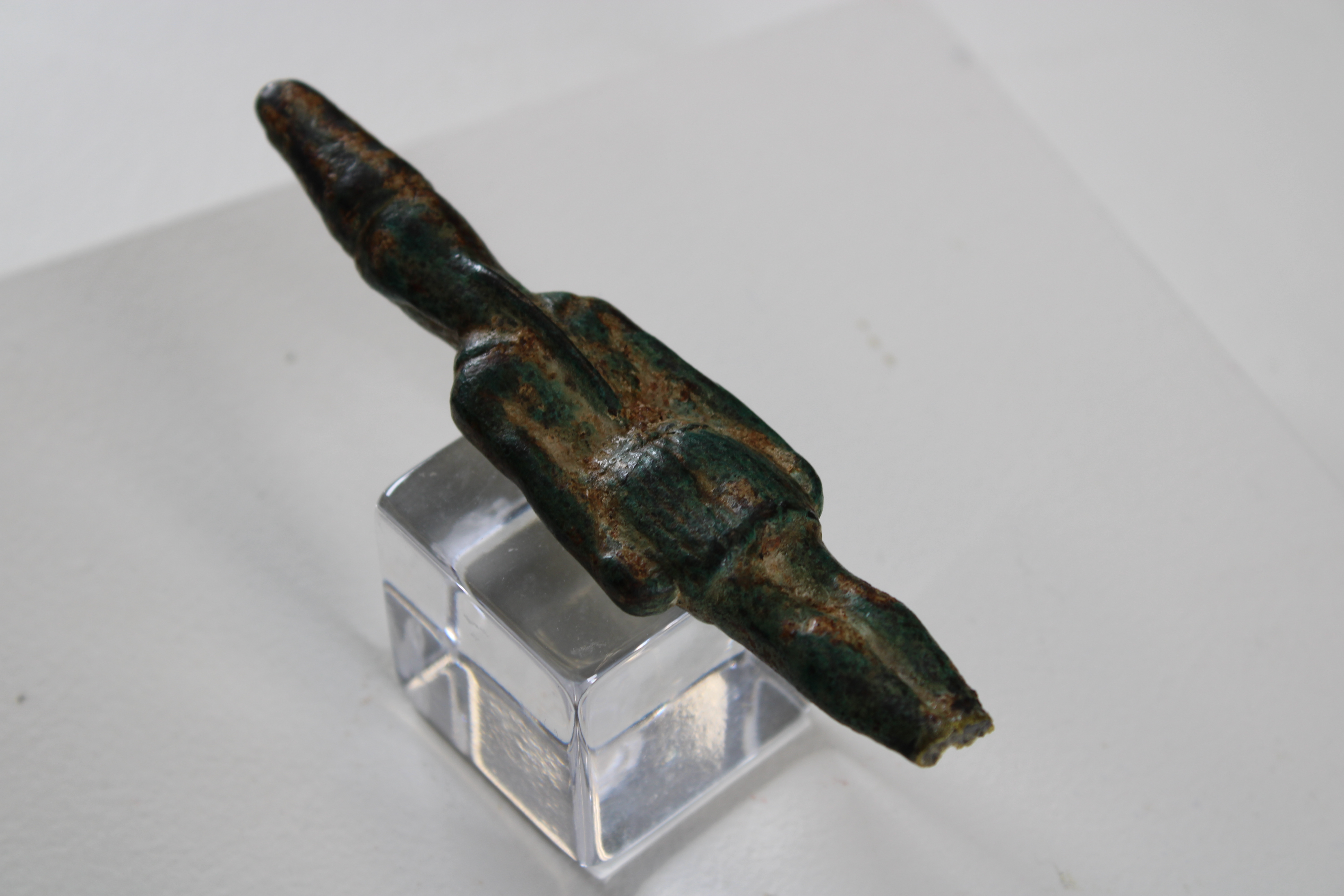
A bronze votive figure of a man wearing a kilt, wide collar, beard, and conical
crown with a rosette. Votive figures in bronze were common throughout the Eastern
Mediterranean in the Archaic period of Greece and the Late Period of Egypt. Like
other art of the period the figure shows a strong Egyptian influence, his crown is
similar to the conical hedjet of Upper Egypt although bearing a rosette. His kilt,
though a common garment in the area, is also sitting in the more traditional
Egyptian position low on the hips and featuring a wide embossed belt. He is wearing
a pharaonic false beard and wide collar, similar to a usekh. On the bottom of the
crown is potentially a sun disk flanked by cobras, a standard pharaonic motif, but
little detail remains. It could also be a floral motif. The figure stands feet
together with his arms at his side, another Egyptian pose.
Credit: From the T.B. Walker
Collection
Sources:
Faegersten, F. (2003). The Egyptianizing, male, limestone statuary from Cyprus: a
study of a cross-cultural, Eastern Mediterranean votive type. [Doctoral Thesis
(monograph), Classical archaeology and ancient history].
https://portal.research.lu.se/en/publications/the-egyptianizing-male-limestone-statuary-from-cyprus-a-study-of-
Ulbrich, A. (2020). Adoption and Adaptation of Greek Iconography in Cypriot Votive
Sculpture of the Late Archaic and Classical Periods. CLASSICAL CYPRUS Proceedings of
the Conference University of Graz, 21-23 September 2017 Κυπριακά - Forschungen Zum
Antiken Zypern Studies on Ancient Cyprus Vol. 5.
Masson-Berghoff (Masson), A. (2015). Bronze votive offerings from Naukratis (2015).
Skuse, M. L. (2015). Greek Interactions with Egyptian Material Culture During the
Archaic Period [Ph.D., University of Exeter (United Kingdom)].
https://www.proquest.com/docview/1779965996/abstract/857A2BF3F6645FAPQ/1
See the item in
the Perlman's Collection!
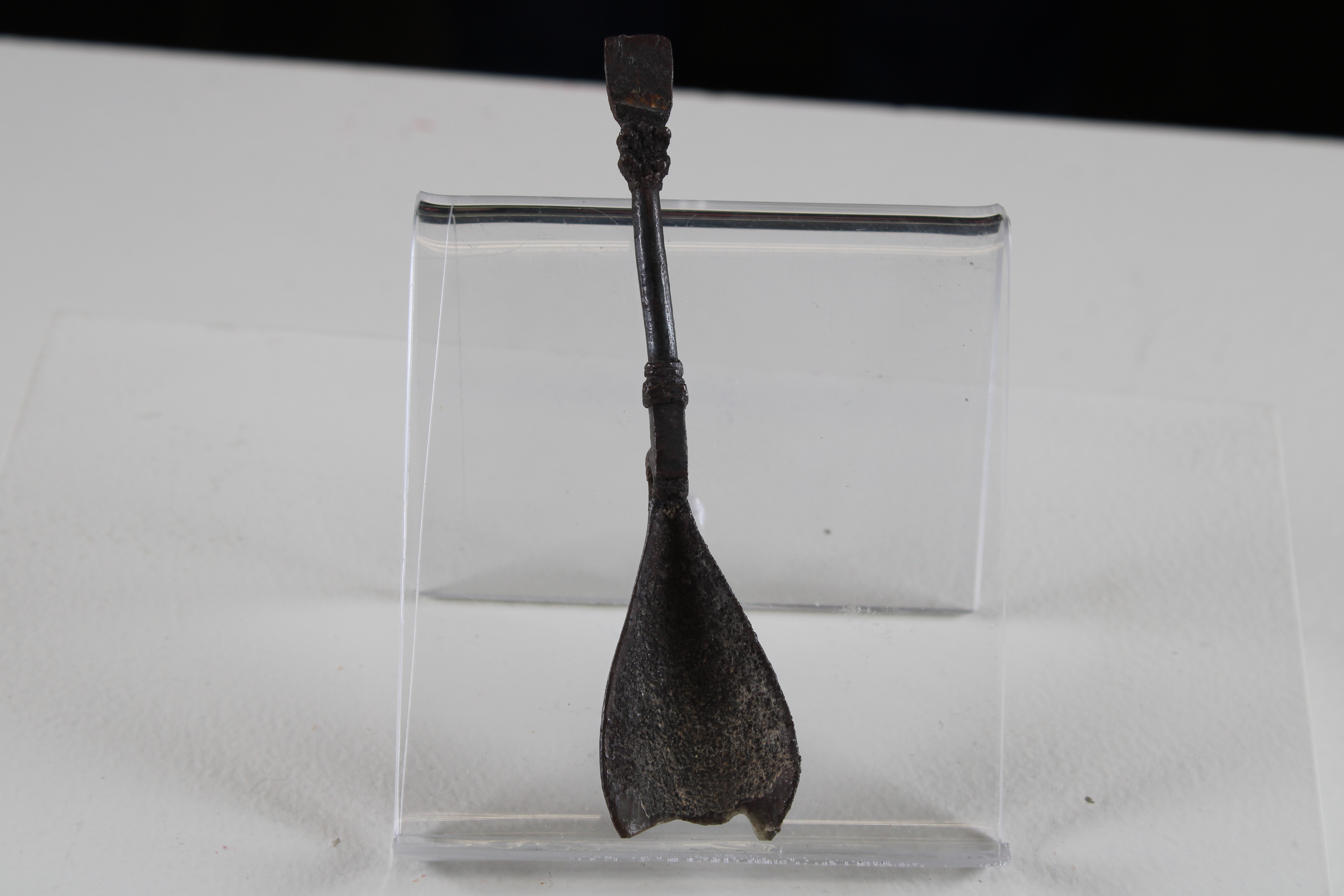
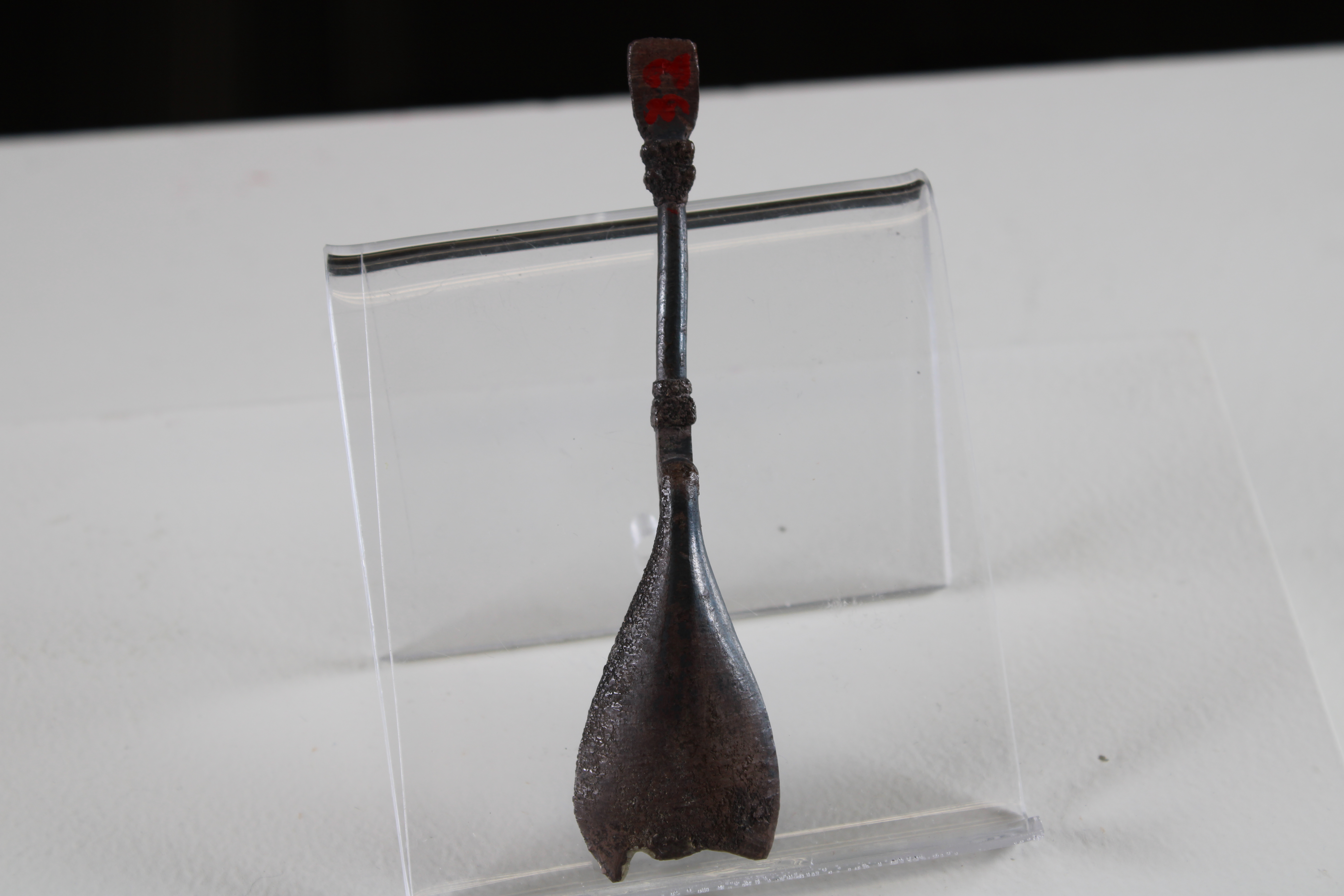
A bronze spoon. It was also found in Beisan and arrived in the Carleton collection
in the same file as the ladle. It was also most likely used for cosmetics and
features decoration near the end of the handle. Hellenistic time period as well, ca.
3rd century BCE.
Credit: Carleton College Art
Collection
Sources:
Liwak, R. (Berlin). (n.d.). Beisan. In Brill's New Pauly Online. Brill.
https://doi.org/10.1163/1574-9347_bnp_e214870

See the item in the
Perlman's Collection!
A thin cast bronze hammer. It shows the center seam from the casting process. It has the
socket in the center for the handle. Resembles a pick-hammer and therefore may have been
for stonework. Uncertain time frame, but listed as “1st Millennium BCE”.
Credit: Carleton College Art
Collection, gift of Percy T. Watson, class of 1903
Sources:
https://penelope.uchicago.edu/Thayer/E/Roman/Texts/secondary/SMIGRA*/Malleus.html
Richter, G. M. A., & Metropolitan Museum of Art (New York, N. Y. ) (with Wellesley
College Library). (1915). Greek, Etruscan and Roman bronzes. New York [The Gilliss
Press].
http://archive.org/details/greeketruscanrom00rich

See the item in the
Perlman's Collection!
A small copper ladle. It was found in the town of Besian, modern day Israel, which was
called Scythopolis in Hellenistic times. The ladle features a delicate and twisted
handle that ends in a hook with a very small bowl, potentially being used for cosmetics.
It is most likely Hellenistic, ca. 3rd century BCE, due to provenance
Credit: Carleton College Art Collection
Sources:
Liwak, R. (Berlin). (n.d.). Beisan. In Brill's New Pauly Online. Brill.
https://doi.org/10.1163/1574-9347_bnp_e214870